NAPTAN REORGANIZES KWARA STATE CHAPTER
May 25, 2026
KWARA STATE EDUCATION TRUST FUND STRENGTHENS BOARD WITH TWO CO-OPTED MEMBERS
July 21, 2026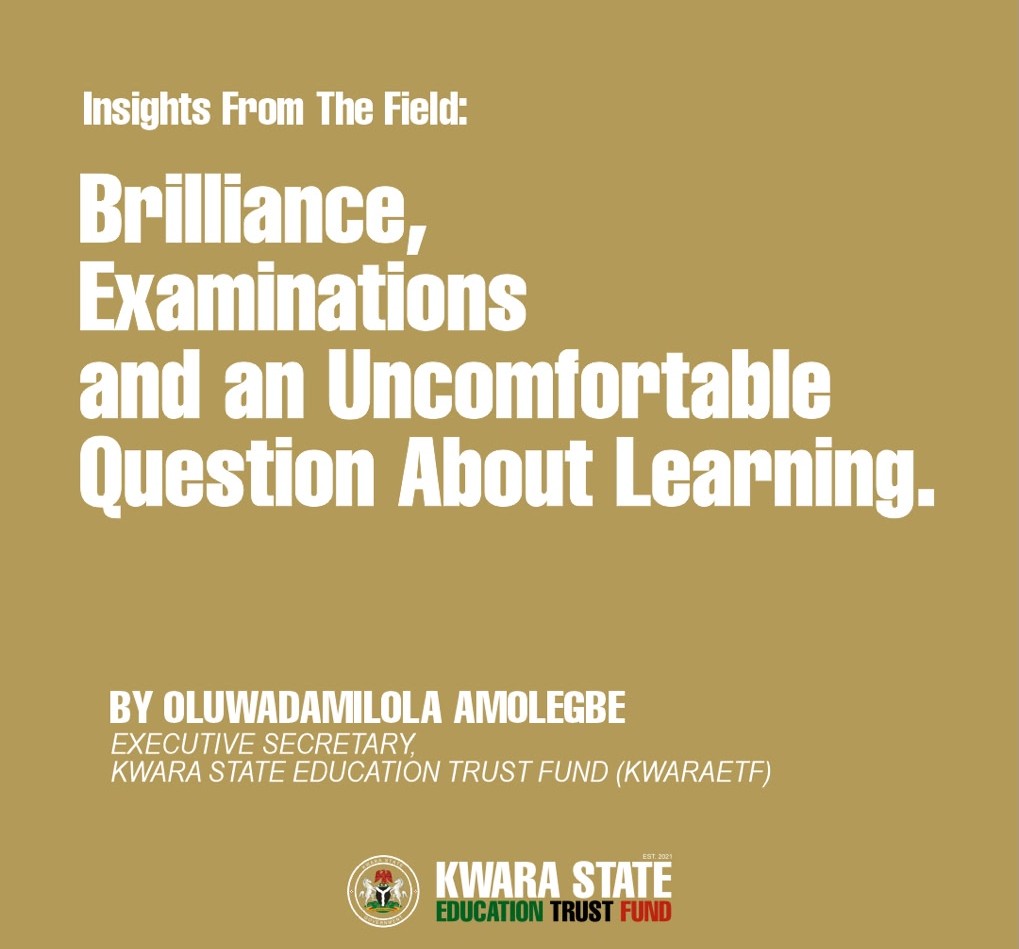
When the Kwara State Education Trust Fund (KwaraETF) launched its scholarship programme for outstanding pupils, the objective was straightforward: identify brilliant children, remove financial barriers, and support them through secondary school.
The selection process was rigorous.
Hundreds of pupils were screened through multiple stages. The strongest performers emerged from a statewide mock examination, proceeded to the National Common Entrance Examination (NCEE), and ultimately secured admission into Federal Unity Colleges across Nigeria.
On paper, everything worked exactly as intended.
The children selected were among the best-performing pupils in the system.
Then something unexpected happened.
As part of routine scholarship monitoring, KwaraETF began tracking the academic performance of its first cohort of beneficiaries in their new schools. While several pupils continued to perform strongly, a group of beneficiaries who had previously ranked among the highest performers recorded surprisingly weak academic results.

At first, there appeared to be a reasonable explanation.
Their schools had experienced disruptions arising from insecurity. Academic calendars had been compressed. Examinations had been rescheduled. It seemed plausible that the challenges of transition and disruption had affected performance.
But when the pattern persisted, the Fund decided to investigate further.
Rather than relying solely on school reports, KwaraETF convened the affected pupils and their parents for a review session and administered an independent diagnostic assessment designed to evaluate foundational competencies in literacy, numeracy, comprehension, reasoning, and general knowledge.
The results raised difficult questions.
The assessment suggested that the academic challenges being observed were not merely the product of school disruption. Significant foundational learning gaps were evident among several pupils.
This finding creates a tension that deserves serious attention.
How can pupils emerge as top performers in highly competitive examinations, secure admission into some of the country’s most prestigious secondary schools, and yet struggle with foundational competencies when assessed independently?
The answer may not lie with the children.
Nor should the immediate response be to assume wrongdoing.
Instead, the findings invite a broader conversation about the relationship between examination success and actual learning.

Across many education systems, examinations are often treated as the ultimate measure of achievement. Yet examinations can sometimes reward memorization, familiarity with question formats, intensive coaching, or short-term preparation strategies. Learning, on the other hand, requires something deeper: the ability to understand, apply, analyze, reason, and build upon foundational knowledge.
The distinction matters.
A child may learn how to pass an examination without fully mastering the concepts the examination is intended to measure. When that happens at scale, examination success can create an illusion of educational progress while underlying learning gaps remain hidden.
This is not merely a scholarship problem.
It is an education system question.
If high-performing pupils are found to have substantial foundational gaps, what does that tell us about the way learning is being assessed? What does it reveal about instructional quality, curriculum delivery, classroom practice, and assessment systems? Most importantly, what does it mean for the thousands of other pupils who may never receive the level of scrutiny or support provided to scholarship beneficiaries?
While this experience is limited to a small cohort of scholarship beneficiaries and should not be generalized without further evidence, it nevertheless raises important questions about how educational success is measured and how learning is sustained beyond examination performance. At a minimum, it challenges us to look beyond scores and rankings and to pay closer attention to whether learners are developing the foundational competencies required for long-term academic success.
Perhaps the most encouraging aspect of this story is not the discovery of the problem, but the response to it.

Rather than withdrawing support or assigning blame, KwaraETF initiated a diagnostic review, engaged parents, involved education stakeholders, and began exploring targeted interventions to help affected pupils improve. More significantly, the findings have prompted discussions about foundational learning outcomes across the wider education ecosystem.
That may prove to be the most important outcome of all.
The purpose of a scholarship programme is not simply to reward achievement. It is to unlock potential.
And sometimes, in the process of supporting a few exceptional children, we uncover lessons that can improve opportunities for many more.
The experience of KwaraETF’s first scholarship cohort reminds us that educational success cannot be measured solely by examination results. Examinations matter. Scholarships matter. Access matters.
But learning matters most.
As education systems increasingly pursue higher pass rates, better rankings, and stronger examination outcomes, we must continue to ask a difficult but necessary question:
Are we measuring learning, or are we measuring performance on tests?
The answer may determine whether brilliance merely passes examinations—or truly fulfills its potential.